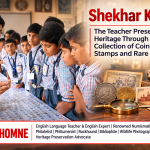
Meet Shri Shekhar Khomne, Maharashtra's teacher and collector with ancient coins, currencies, stamps, books and natural treasures, who has organised 20 educational exhibitions.
Shri Shekhar Khomne: Preserving India's Heritage Through an Extraordinary Collection of Coins, Currencies, Stamps, Books and Natural Treasures
From ancient coins dating back to the 6th century BC to currencies from 50 countries, postal stamps from 60 nations, rare matchbox labels, unusual stones, wildlife photography and a personal library of English reference books, Maharashtra-based teacher and collector Shri Shekhar Khomne has transformed his passion for collecting into an educational mission. Through 20 exhibitions organised at different colleges, he is taking history, geography, nature and knowledge beyond classroom walls and bringing them closer to students.
In a small village called Pimpalgaon Raja, located in Khamgaon taluka of Buldhana district, Maharashtra, an extraordinary world of history, knowledge and discovery has been quietly taking shape. It is not housed in a major museum or a commercial exhibition centre. Instead, it has grown through the curiosity, dedication and lifelong passion of an English language teacher who believes that valuable knowledge should never remain hidden away.
Meet Shri Shekhar Khomne, an English language teacher, English expert, renowned numismatist, philatelist, philumenist, bibliophile and passionate rockhound. His interests extend across several fascinating fields, bringing together history, currencies, postage stamps, books, wildlife photography, matchbox collections, stones and crystals.
What makes his journey particularly meaningful is not simply the scale of his collection, but the purpose behind it. He believes that collections have little educational value if they remain locked away in trunks and cupboards. They should be displayed, discussed and shared with people who can learn from them.
With approximately 1,100 Indian ancient and foreign coins, 1,100 Indian and international currencies, 1,500 postal stamps, 1,000 matchbox pictures, 200 distinctive stones and crystals from six countries, and a personal library of English-language books, Khomne has created a remarkable collection that reflects years of curiosity and commitment.
He has also organised 20 exhibitions at different colleges, making these collections accessible to students and encouraging younger generations to discover the stories hidden within objects that many people might otherwise overlook.
His journey is a story of education beyond textbooks, the preservation of cultural heritage and the belief that one person's passion can become a valuable learning opportunity for an entire community.
The Beginning of a Passion: When a School Lesson Changed Everything
Every meaningful journey has a beginning, and for Shekhar Khomne, the inspiration came from an ordinary classroom experience.
As an English language teacher at P. M. Shri Zilla Parishad High School and Junior College, Pimpalgaon Raja, he once came across a lesson in the Grade 8 coursebook that described British India coins.
The lesson introduced students to historical coins, but the illustrations in the textbook were not sufficiently clear to satisfy their curiosity. The students wanted to understand what these coins actually looked like. They were interested in their appearance, historical significance and distinctive features.
Khomne recognised that the subject could become much more engaging if students had the opportunity to see genuine coins rather than rely entirely on printed pictures.
That classroom experience planted an idea: he would begin collecting coins himself so that students could experience history more directly.
What started as an educational initiative gradually developed into a much larger collection. His curiosity expanded beyond British India coins to ancient Indian currency, foreign coins, princely-state issues, commemorative coins and unusual minting errors.
The collection eventually became an extensive personal treasure, bringing together objects from different periods, places and traditions.
For Khomne, the most important discovery was that an object as small as a coin could open a much larger conversation about history, culture, geography, economics and the evolution of human civilisation.
A Renowned Numismatist with an Extensive Coin Collection
Numismatics, the study and collection of coins, is one of the most significant dimensions of Khomne's collecting journey.
His collection includes approximately 1,100 Indian ancient and foreign coins, representing different historical periods, monetary traditions and coin-making styles.
It brings together a fascinating range of pieces, from early historical coinage to modern commemorative issues. Each category offers a different opportunity to understand the past.
Among the important categories represented in his collection are:
Ancient Coins: Coins associated with historical periods dating back to the 6th century BC.
Punch-Marked Coins: Among the historically significant early Indian coin types.
Princely State Coins: Coins associated with the former princely states of the Indian subcontinent.
British Era Coins: Currency issued during the period of British rule in India.
Medieval Period Coins: Coins reflecting monetary traditions from different medieval periods.
Modern Coins: Contemporary Indian and international coinage.
Commemorative Coins: Coins issued to recognise important personalities, occasions and national milestones.
Silver Coins: Including a 100-rupee silver coin.
Special Commemorative Issues: Including a 75-rupee coin.
Error Coins: Unusual minting examples, including planchet errors and off-centre strikes.
Coins as Windows into History
A coin is much more than a piece of metal used for financial exchange. It can preserve the image of a ruler, a symbol of authority, a national emblem, a historical inscription or an artistic representation of a particular era.
For students, examining coins from different periods can make history more tangible. They can observe changes in designs, scripts, materials and manufacturing techniques while developing an understanding of how monetary systems evolved.
Punch-marked coins, princely-state issues and British-era currency also provide opportunities to discuss different political and economic periods in Indian history.
Khomne's collection offers an opportunity to explore these subjects through physical objects rather than illustrations alone.
His interest in error coins adds another dimension. Planchet errors and off-centre strikes demonstrate how variations can occur during the minting process. Such examples can introduce students to the technical side of coin production and the importance of careful observation.
The collection is therefore not merely an assortment of old currency. It is a learning resource that connects history with material culture.
Exploring the World Through Currencies from 50 Countries
Alongside his coin collection, Khomne has assembled approximately 1,100 Indian and foreign currencies, including banknotes from around 50 countries.
International currencies provide a fascinating perspective on the diversity of nations and their identities.
Banknotes often feature national leaders, historical personalities, monuments, wildlife, cultural symbols, architectural landmarks and important national achievements.
By studying currencies from different countries, students can discover how nations represent their history and identity through everyday objects.
A collection of international banknotes can also introduce learners to world geography. Each currency represents a country, a monetary system and a cultural background. Students can compare designs, denominations, languages and visual features while developing an interest in international affairs.
For young learners in a small village, seeing currencies from approximately 50 countries can be an exciting introduction to the wider world.
It demonstrates that education does not need to be restricted to the boundaries of a classroom or the pages of a textbook.
A Passionate Philatelist with Stamps from 60 Countries
Another important part of Khomne's collection is philately, the study and collection of postage stamps.
He has accumulated approximately 1,500 postal stamps from 60 countries, creating another valuable collection that reflects his interest in history, culture and international heritage.
Postage stamps are small but significant cultural objects. They frequently commemorate national events, historical personalities, scientific achievements, important institutions, wildlife, traditional art and cultural celebrations.
For collectors, each stamp can represent a story about the country that issued it.
A collection spanning 60 countries provides an opportunity to observe how different nations present their identities through miniature printed designs.
It also introduces students to geography, historical events and cultural diversity in a visually engaging way.
Khomne's interest in philately complements his numismatic collection. While coins and currencies reveal the evolution of monetary systems, postage stamps offer another perspective on national history and communication.
Together, they create an educational bridge between the past and the present.
A Renowned Philumenist: Preserving the Forgotten Art of Matchbox Pictures
One of the most unusual aspects of Khomne's collection is his interest in philumeny, the collecting of matchboxes, matchbox labels and related material.
A renowned philumenist, he has collected approximately 1,000 matchbox pictures.
His collection includes examples associated with countries such as Tunisia, Sri Lanka and Vietnam, adding an international dimension to this distinctive hobby.
Matchbox labels are often overlooked as ordinary packaging. However, their designs can preserve interesting examples of commercial artwork, typography, illustration and visual communication.
They may feature animals, landscapes, cultural symbols, national imagery, company identities and traditional design styles.
For collectors, these small printed objects offer an opportunity to study changing artistic preferences and commercial design across different countries and periods.
Khomne's matchbox-picture collection demonstrates his ability to find historical and cultural interest in objects that many people might consider disposable.
It also reflects a broader philosophy behind his collecting journey: valuable stories can be found in unexpected places.
A Rockhound with 200 Unique Stones and Crystals from Six Countries
Khomne's interests extend beyond historical and printed objects into the natural world.
As a passionate rockhound, he has collected approximately 200 stones and crystals from six different countries.
The collection includes stones and crystals distinguished by their unique shapes and appearances.
Natural stones provide an opportunity to explore geology, mineral diversity and the processes that shape the Earth's surface over long periods.
Their colours, patterns, textures and structures can encourage curiosity about how different minerals form and how geological conditions influence their appearance.
For students, such collections can make subjects such as geography and earth science more interesting. Seeing unusual stones and crystals in person can inspire questions about their origins, composition and natural characteristics.
Khomne's rock collection adds a scientific and nature-oriented dimension to an otherwise history-focused collection.
It demonstrates that his curiosity is not limited to human civilisation. He is equally interested in the natural processes that have shaped the world.
A Wildlife Photographer Documenting Maharashtra's Local Birds
Beyond collecting physical objects, Khomne has developed a strong interest in wildlife photography.
He is an acclaimed wildlife photography enthusiast who has captured colourful photographs of approximately 40 local bird species in Maharashtra.
Bird photography requires patience, observation and an understanding of natural surroundings. Capturing a bird in its natural environment involves waiting for the right moment, recognising its behaviour and observing its movement without disturbing it.
His photographs reflect an appreciation for Maharashtra's local biodiversity and the colourful birdlife found in the region.
Wildlife photography also offers an educational opportunity. Photographs can introduce students to local species, their colours, physical characteristics and natural habitats.
For students growing up in rural surroundings, learning to observe nearby birds can create a stronger connection with the environment.
Khomne's interest in bird photography complements his collections of coins, stamps and stones by adding a living dimension to his educational interests.
It also reinforces an important message: heritage is not limited to historical monuments and valuable objects. The natural world surrounding us is equally worthy of attention and preservation.
A Bibliophile with a Personal Library of English Reference Books
Books occupy another important place in Khomne's life.
As a bibliophile, he has developed a personal library containing approximately 1,000 English-language books.
The library includes encyclopedias, reference books and a collection of 34 dictionaries.
Rather than treating the library as a private collection meant only for personal use, Khomne has made it a learning resource for students, particularly those from nearby villages.
Students from rural backgrounds make use of the books available in his personal library, gaining access to reference material that can support their language development, vocabulary, reading habits and general knowledge.
The Importance of Dictionaries and Reference Books
Language learning requires more than classroom instruction. Students need opportunities to read, explore words, understand meanings and develop confidence in communication.
Dictionaries are particularly useful because they help learners understand spelling, pronunciation, definitions and different uses of words.
Having 34 dictionaries in one personal collection reflects Khomne's interest in the depth and diversity of the English language.
Encyclopedias and reference books provide another level of learning by helping students explore subjects beyond their regular syllabus.
For students in a small village, access to a personal reference library can be valuable. It offers an opportunity to develop independent reading habits and discover information at their own pace.
His library represents one of the most meaningful aspects of his educational contribution because it transforms his personal interest in books into an accessible learning opportunity for others.
Twenty Exhibitions: Taking Heritage Beyond the Classroom
Perhaps the most meaningful part of Shekhar Khomne's journey is his decision to share his collections with students through exhibitions.
He has organised 20 exhibitions at different colleges, allowing students to view coins, currencies and other collected objects in person.
The purpose behind these exhibitions is clear: he wants students from other schools and colleges to experience the value of historical coins and currencies rather than remain limited to textbook illustrations.
His philosophy is straightforward. Valuable collections should not remain hidden in trunks.
A coin that has survived centuries, a currency note from another country, a postage stamp commemorating a national achievement or a rare matchbox picture can become a powerful learning tool when placed before an interested student.
The exhibitions create opportunities for young people to ask questions, examine objects closely and discover subjects that they may not otherwise encounter in their regular academic environment.
Making History Accessible to Rural Students
Khomne's village, Pimpalgaon Raja, is a small rural community. His work demonstrates how educational initiatives can emerge from smaller places and reach wider student communities.
Students in villages and smaller towns may not always have easy access to large museums, specialist exhibitions or extensive collections.
By taking his collection to educational institutions, Khomne brings these experiences closer to them.
The exhibitions can help students understand that history is not simply something to memorise for examinations. It can be explored through physical evidence, careful observation and curiosity.
A student who sees a historical coin for the first time may develop an interest in ancient history. Another may become fascinated by foreign currencies, postage stamps or natural stones.
Such experiences can inspire interests that continue long after the exhibition has ended.
An Educational Mission Beyond Personal Collecting
For many collectors, the satisfaction comes from acquiring a rare or unusual object.
Khomne's approach adds another purpose: sharing.
He wants students to see the collections, understand their significance and develop their own interest in history and knowledge.
The 20 exhibitions organised at different colleges represent an effort to turn individual passion into a shared educational experience.
His work also demonstrates the value of informal learning. Education does not happen only through lessons delivered by teachers. It can also take place through exhibitions, conversations, observation and direct interaction with objects.
An English Teacher Who Believes in Learning Beyond Textbooks
While his collections have attracted attention, Shekhar Khomne's primary professional identity remains that of an educator.
He serves as an English language teacher and English expert at P. M. Shri Zilla Parishad High School and Junior College, Pimpalgaon Raja, Khamgaon, Maharashtra.
Teaching English involves helping students develop the skills required to communicate confidently, read effectively and express ideas clearly.
His personal library of approximately 1,000 English-language books and 34 dictionaries reflects his interest in language and reference learning.
His approach to education also demonstrates how classroom experiences can inspire practical initiatives.
The original Grade 8 lesson on British India coins led him towards numismatics. His collecting journey, in turn, created opportunities for students to experience history outside conventional textbooks.
This connection between teaching and collecting is central to his identity.
He does not view his hobbies as separate from education. Instead, they provide additional ways to encourage curiosity, observation and independent learning.
His contribution to teaching has also been recognised through national awards for his work in education.
These recognitions form part of his professional journey as an educator committed to learning and student development.
One Collector, Many Fields of Knowledge
What makes Khomne's collection particularly distinctive is the diversity of his interests.
Each field represents a different way of understanding the world.
Area of Interest
Collection or Contribution
Numismatics
Approximately 1,100 Indian ancient and foreign coins
Currency Collection
Approximately 1,100 Indian and foreign currencies from 50 countries
Philately
Approximately 1,500 postal stamps from 60 countries
Philumeny
Approximately 1,000 matchbox pictures
Rockhounding
Approximately 200 unique stones and crystals from six countries
Wildlife Photography
Colourful photographs of approximately 40 local bird species in Maharashtra
Bibliophily
Personal library of approximately 1,000 English-language books
Dictionaries
34 dictionaries in his personal collection
Educational Outreach
20 exhibitions organised at different colleges
These collections bring together history, geography, language, science, art, nature and cultural heritage.
They also demonstrate that knowledge does not always develop through one specialised field. Sometimes, curiosity in one area leads to an entirely different discovery.
A coin can lead to history. A stamp can lead to geography. A stone can lead to geology. A bird photograph can lead to environmental awareness. A dictionary can lead to a deeper understanding of language.
In Khomne's case, these interests have developed into a broad collection of learning resources.
Preserving Indian Heritage and Inspiring the Next Generation
Khomne's larger objective is to uphold Indian heritage through exhibitions and educational awareness.
India has a long and diverse history reflected in its coins, currencies, languages, literature, traditions and cultural objects.
Historical coins, in particular, offer an opportunity to understand different periods of Indian civilisation. Their designs, inscriptions and materials can reveal information about rulers, political systems, trade, art and monetary practices.
By displaying such objects to students, Khomne hopes to encourage a greater appreciation of the country's past.
His interest in international currencies and stamps adds a global perspective, helping students understand that Indian heritage can be explored alongside the histories and cultures of other nations.
The combination of Indian historical collections and international material creates a learning experience that connects local curiosity with global awareness.
For Khomne, the purpose is not simply to preserve objects. It is to preserve the knowledge and stories associated with them.
Pimpalgaon Raja: A Small Village with a Remarkable Educational Story
Pimpalgaon Raja, in Khamgaon taluka of Buldhana district, Maharashtra, is the village where Khomne's teaching and collecting journey is rooted.
The rural setting is an important part of his story.
His work demonstrates that meaningful educational contributions do not always require large institutions, major funding or metropolitan infrastructure.
A dedicated teacher can build a valuable personal collection, organise exhibitions, make books accessible and inspire students through consistent effort.
The presence of his personal library and the exhibitions organised at different colleges reflect an approach centred on access to knowledge.
For students from smaller communities, these initiatives can help create opportunities to discover interests that extend far beyond their immediate surroundings.
Khomne's journey is a reminder that the desire to learn, preserve and share knowledge can grow anywhere.
The Legacy of a Teacher, Collector and Heritage Enthusiast
Shri Shekhar Khomne represents a distinctive combination of educator, collector, nature enthusiast and cultural preservationist.
His collection spans ancient and modern coins, international currencies, postal stamps, matchbox pictures, stones and crystals, wildlife photographs and an extensive personal library.
Yet the most important part of his journey is the decision to make these interests useful to others.
The 20 exhibitions organised at different colleges reflect his commitment to sharing knowledge. His personal library offers students access to books and reference material. His wildlife photography encourages appreciation of local biodiversity. His collections create opportunities to explore history, geography, culture and science through real objects.
His journey began with a simple classroom observation: students wanted to see actual historical coins instead of unclear textbook illustrations.
That small moment developed into a collection that now represents several fields of knowledge.
It is a powerful example of how a teacher's curiosity can become an educational mission.
For Khomne, the value of a collection is not measured only by the number of objects it contains, their age or their rarity. Its real value lies in the knowledge it can share and the curiosity it can inspire.
From the historical significance of a 6th-century BC coin to the design of an international postage stamp, from the colours of a local bird to the pages of an English dictionary, every item offers an opportunity to learn something new.
In a world where information is increasingly available through digital screens, his exhibitions remind students of the unique experience of seeing, examining and understanding real objects.
Shri Shekhar Khomne's story is ultimately about making knowledge visible, keeping heritage alive and ensuring that the treasures of the past become learning opportunities for the future.
PERSONALITY PROFILE
Name: Shri Shekhar Khomne Profession: English Language Teacher and English Expert Institution: P. M. Shri Zilla Parishad High School and Junior College Location: Pimpalgaon Raja, Khamgaon, Buldhana district, Maharashtra, India Specialisations and Interests: Numismatics, Philately, Philumeny, Bibliophily, Rockhounding and Wildlife Photography Educational Outreach: 20 exhibitions organised at different colleges Primary Mission: Preserving Indian heritage and encouraging students to learn through historical collections and educational exhibitions.
A message behind his journey: Valuable historical objects should not remain hidden in trunks. They should be brought before students so that the next generation can see, understand and appreciate the heritage they represent.
Discover Adithapson's journey since 1973. Anil and Aditya Thapar lead a family legacy in bespoke men's tailoring and fashion design across Chandigarh and Panchkula.
Discover Dr. Sravanthi Ellasri's journey from dentistry to entrepreneurship, building Boxwish, S-Infra Heights and Toothwish 24/7 Dental Hospital in Telangana.